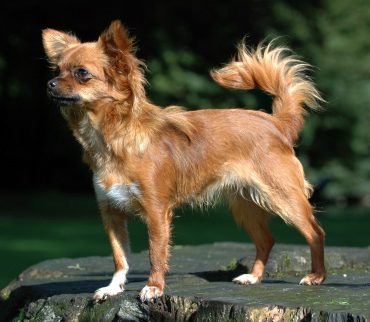
Photo: Bonnie van den Born, CC BY-SA 3.0, via Wikimedia Commons

- Size
- Toy
- Height
- 13–20 cm
- Weight
- 1–2.7 kg
- Energy
- Moderate
- Intelligence
- Moderate
Overview
The Chihuahua is the smallest recognized breed, a large-eyed companion from Mexico that comes in smooth and long coats. Bold, attached, and often unaware of its size, it is a true house dog that still needs manners and dental care.
Origin
Small dogs existed in pre-Columbian Mesoamerica; the Techichi of the Toltecs is often cited as an ancestor, though the exact path is debated. The modern breed takes its name from the Mexican state of Chihuahua, where American travelers obtained dogs in the late nineteenth century. The AKC registered the breed in 1904.
Size & weight
AKC: not to exceed 2.7 kg. There is no official teacup variety—that marketing term often means fragile, poorly bred undersized dogs. Heads may be apple (desired in AKC) or deer-type.
Temperament
Terrier-like confidence in a toy body. Devoted to their person, they can be snappy if startled, poorly socialized, or allowed to write the household rules. They often dislike rough handling and may be noisy watchdogs. Socialize early and often.
Energy
Moderate. Indoor play plus short walks. They shiver in the cold and can sprint across an apartment. Mental work (tricks, scent games) reduces yapping born of boredom.
Intelligence
Alert and bonded to their people, Chihuahuas can learn manners, but typical trainability is that of a companion, not a working dog.
Intelligence here means typical trainability, not a ranking of the dog.
Coat & grooming
Smooth (close, glossy) or long (soft, flat or slightly wavy, with a ruff and plume). Any color or pattern except merle in some registries that have restricted it.
Smooths need a wipe and shed management. Long coats need combing. Dental hygiene is the grooming item that actually changes lifespan. Provide coats in cold weather.
Health notes
Patellar luxation, hypoglycemia in tiny puppies, collapsing trachea, and heart disease (including patent ductus arteriosus and later mitral valve disease) occur. Open fontanelles (molera) are common and require a gentle hand on the skull. Hydrocephalus appears in some lines. Dental crowding and periodontal disease are nearly universal without care.
Care
Do not treat them as infants; teach floor manners and polite greetings. Supervise around large dogs and heavy doors. Use ramps. Keep them warm. Feed a diet they can chew, and brush the teeth.
Fun facts
- The molera, a soft spot on the skull, is a recognized breed trait, unlike in most dogs.
- A Chihuahua named Gidget appeared in Taco Bell advertisements in the 1990s.
- They are among the longest-lived breeds when teeth and trauma are managed, often into the mid-teens.
The Dog Codex is an editorial reference, not veterinary advice. Health notes summarize conditions that appear in breed literature; they do not diagnose an individual dog and do not replace examination by a licensed veterinarian.