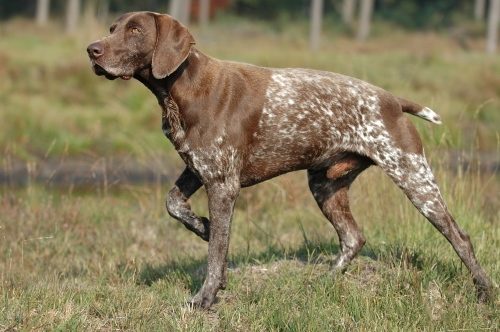
Photo: Bonnie van den Born, http://www.bonfoto.nl, CC BY-SA 3.0, via Wikimedia Commons

- Size
- Large
- Height
- 53–64 cm
- Weight
- 20–32 kg
- Energy
- Very high
- Intelligence
- High
Overview
The German Shorthaired Pointer is a versatile hunting dog built to point, track, retrieve on land and water, and work a full day over open country. Lean, liver or liver-and-white, and ceaselessly athletic, it is a poor match for a quiet apartment and an excellent match for a hunter or runner.
Origin
Nineteenth-century German hunters wanted one dog that could do the work of several English specialists. They crossed Spanish pointers, Hanoverian hounds, and later English Pointer blood to produce the Deutsch Kurzhaar. The breed arrived in the United States in the 1920s and was AKC-recognized in 1930.
Size & weight
Males 58–64 cm; females 53–59 cm. The outline should be square to slightly rectangular, with a deep chest and a docked or naturally short tail carried horizontally when working.
Temperament
Intelligent, keen, and bonded to its people. GSPs are typically friendly but can be reserved with strangers. They need a job; without one they invent scent work in the sofa. Early training is essential because the hunting drive comes online young and is powerful.
Energy
Very high. This is an all-day field dog. A walk around the block will not suffice. Running, hunting, swim retrieves, and advanced training are appropriate outlets. Adolescents can be whirlwinds for two years or more.
Intelligence
A versatile hunting dog that learns field and obedience work well, though the hunting drive can outrun a casual handler.
Intelligence here means typical trainability, not a ranking of the dog.
Coat & grooming
Short, dense, and tough, lying close to the body. Colors: solid liver, liver and white spotted, liver ticked, or roan. A patch of white on the chest is common. The coat sheds dirt and water more readily than long-coated gundogs.
Minimal: a rubber curry or hound glove weekly, baths when dirty. Check ears, feet, and undercarriage after field work for burrs, cuts, and awns. Nails wear down in active dogs but still need monitoring.
Health notes
Hip dysplasia, von Willebrand disease, and certain cancers (including hemangiosarcoma) occur. Entropion and other eyelid issues appear. Gastric dilatation-volvulus is a risk in deep-chested dogs; owners should know the signs. Some lines carry a lymphedema predisposition.
Care
Plan for weatherproof outdoor work and a calm indoor down-stay. Crate training and place work save the furniture. They generally live well with other dogs if raised together but may chase small running animals. Mental fatigue from scent and obedience work is as important as miles.
Fun facts
- German hunters scored the breed on a versatile hunting test, not on a single specialty.
- The liver pigment and ticked coat helped the dog remain visible in cover without flashing like a solid white pointer.
- GSPs have succeeded in agility, dock diving, and search work as readily as in the duck blind.
The Dog Codex is an editorial reference, not veterinary advice. Health notes summarize conditions that appear in breed literature; they do not diagnose an individual dog and do not replace examination by a licensed veterinarian.