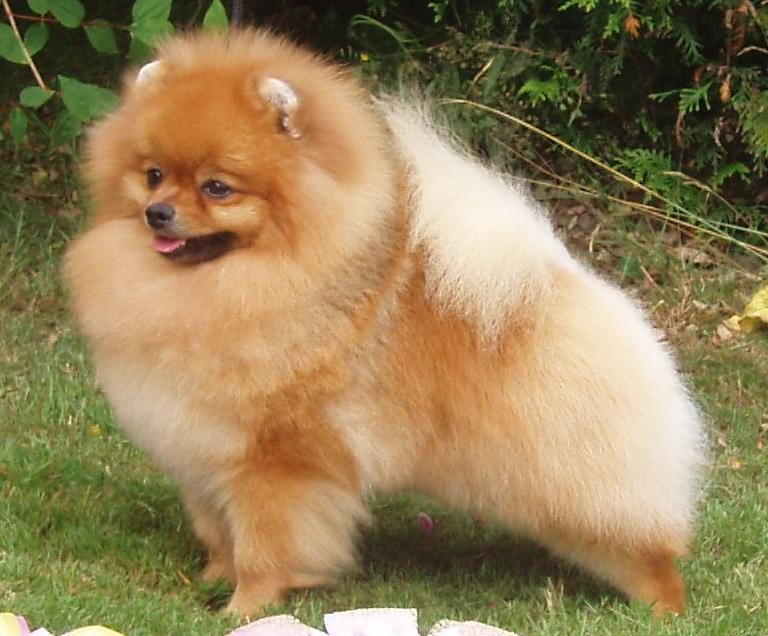
Photo: Blackoranges, Public domain, via Wikimedia Commons

- Size
- Toy
- Height
- 15–18 cm
- Weight
- 1.4–3.2 kg
- Energy
- Moderate
- Intelligence
- Moderate
Overview
The Pomeranian is a toy spitz: a fox-faced, heavily coated miniature of larger European sled and herding spitzes. Alert, busy, and often louder than its kilograms suggest, it is a companion with a working dog's self-importance packed into a cloud of stand-off coat.
Origin
Spitz dogs from the Pomerania region (today in Poland and Germany) were originally much larger. In the eighteenth and nineteenth centuries they were fashionable in Britain; Queen Victoria's small red Pomeranian, Windsor's Marco, accelerated downsizing. The modern toy was AKC-recognized in 1888 and became a fixture of the toy group.
Size & weight
AKC ideal is 1.4–3.2 kg, with 1.8–2.3 kg preferred. Oversized Poms are common as pets. The outline is square, with a foxy head and a plumed tail lying on the back.
Temperament
Inquisitive, attached to household members, and often suspicious of strangers and other dogs if not socialized. They can be sharp-voiced watchdogs. Many have a clownish play style. They should not be treated as ornaments; they have opinions.
Energy
Moderate. Indoor play and several short walks suit most. They enjoy tricks and agility scaled to tiny jumps. They chill in weather that would delight a husky, despite the coat, because of low mass.
Intelligence
Toy companions of spitz heritage: Pomeranians are alert and can learn tricks, but they were not bred for formal working obedience.
Intelligence here means typical trainability, not a ranking of the dog.
Coat & grooming
A double coat: a short, dense undercoat and a long, harsh, stand-off outer coat forming a ruff. All colors and patterns are allowed, from orange and red to black, cream, merle, and parti.
Several brushings a week to prevent mats at the ears, trousers, and behind the legs. Do not shave to the skin except medically; coat may not regrow correctly. Regular dental care is critical in this tiny mouth.
Health notes
Patellar luxation, tracheal collapse, and dental crowding are common. A breed-associated alopecia ('black skin disease') causes coat loss. Patent ductus arteriosus and other congenital heart defects occur. Hypoglycemia is a risk in tiny puppies. Open fontanelles appear in some very small dogs.
Care
Supervise around large dogs and doors; they are easily injured. Use a harness rather than a collar if the trachea is a concern. Teach quiet; the bark is otherwise a lifestyle. Keep teeth clean. They are not outdoor dogs.
Fun facts
- Mozart named his Pomeranian Pimperl; Queen Victoria's Marco helped set the toy type.
- Two Pomeranians survived the Titanic, carried off in their owners' coats.
- The Pomeranian is the toy member of the German Spitz family that also includes the Keeshond and German Wolfspitz.
The Dog Codex is an editorial reference, not veterinary advice. Health notes summarize conditions that appear in breed literature; they do not diagnose an individual dog and do not replace examination by a licensed veterinarian.