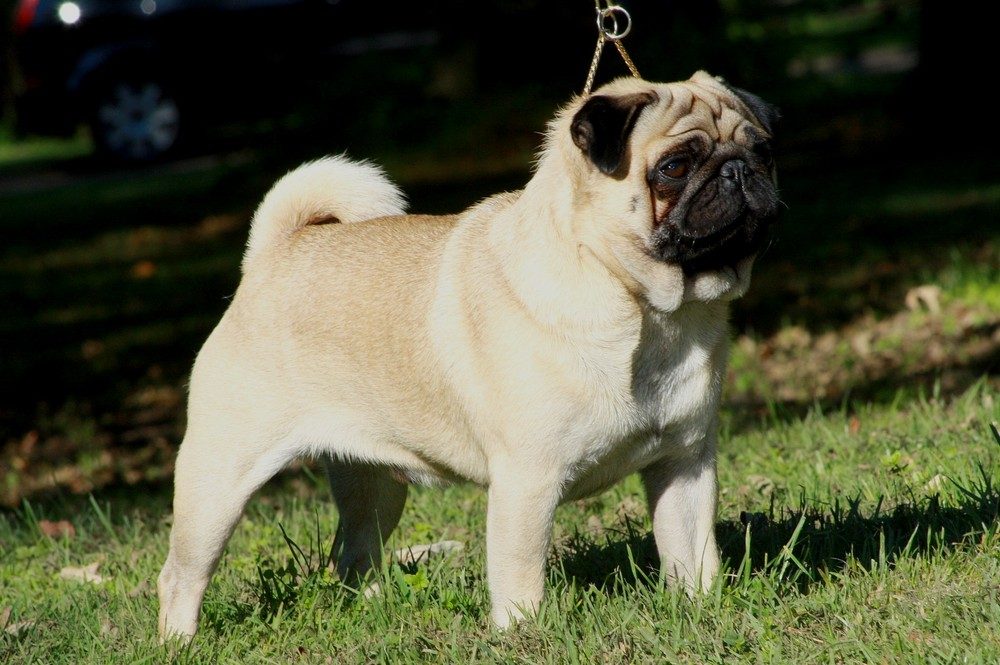
Photo: Xidrep, CC BY-SA 3.0, via Wikimedia Commons

- Size
- Small
- Height
- 25–33 cm
- Weight
- 6–8 kg
- Energy
- Low
- Intelligence
- Moderate
Overview
The Pug is a compact, wrinkle-faced companion from China, with a curled tail and a square, cobby body. Charming and comedic, it is also a brachycephalic breed: heat, airways, and eyes are management issues, not trivia.
Origin
Short-faced dogs were kept in Chinese imperial courts for centuries and reached Europe with Dutch traders, becoming favorites in the Netherlands and later in Georgian and Victorian Britain. The AKC recognized the Pug in 1885. Modern exaggeration of the flat face has increased respiratory difficulty compared with earlier, slightly longer-muzzled pugs.
Size & weight
Square and thick-set, not weedy. The standard calls for a compact dog of 6–8 kg. The tail is a tight curl, preferably a double curl.
Temperament
Even-tempered, sociable, and typically good with people. Pugs want to be in the room. They can be stubborn in training and are skilled beggars. They are not yappy in the Pomeranian sense but will snort, snore, and comment.
Energy
Low to moderate. Short walks and indoor play suffice; they overheat quickly. Obesity turns a low-energy dog into a medical problem. Do not jog them in humidity.
Intelligence
Pugs are companion clowns more than working pupils; they learn household routines, motivated more by comfort and food than by a job.
Intelligence here means typical trainability, not a ranking of the dog.
Coat & grooming
Fine, smooth, short, and glossy, in fawn with a black mask or in solid black. Silver fawns occur. Shedding is surprisingly heavy for a short coat.
Daily wipe of facial wrinkles to prevent fold infections. Weekly brushing for shed. Eyes may need cleaning. Nails and the tail pocket (if present) should be checked.
Health notes
Brachycephalic obstructive airway syndrome is central: stenotic nares, elongated palates, and heat intolerance. Corneal ulcers are common because of prominent eyes. Pug dog encephalitis is a breed-specific inflammatory brain disease. Hemivertebrae may accompany screw tails. Skin-fold dermatitis and obesity-related disease are everyday concerns.
Care
Keep them slim—you should feel ribs. Use a harness. Never leave them in a warm car or even a warm room with poor airflow. Choose breeders working toward more open nostrils and slightly longer muzzles where possible. This is indoor life, with climate control in summer.
Fun facts
- The Dutch called them Mopshond; they became associated with the House of Orange.
- A pug named Fortune was a favorite of Josephine Bonaparte.
- The breed's motto in some club materials is 'multum in parvo'—much in little.
The Dog Codex is an editorial reference, not veterinary advice. Health notes summarize conditions that appear in breed literature; they do not diagnose an individual dog and do not replace examination by a licensed veterinarian.