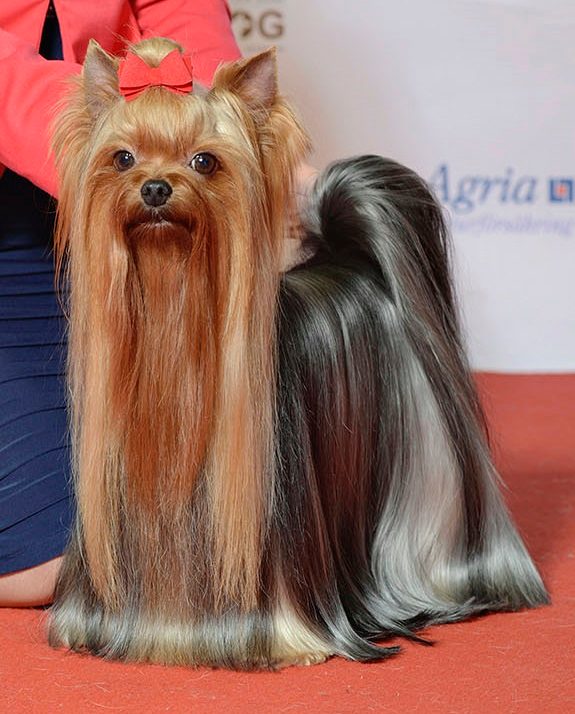
Photo: Svenska Mässan, CC BY-SA 4.0, via Wikimedia Commons
_Grupp_3,_YORKSHIRETERRIER,_NO_UCH_SE_UCH_Oxzar_Amazing_Bel%E2%80%99s_Toffy_(24310212305).jpg)
- Size
- Toy
- Height
- 18–20 cm
- Weight
- up to 3.2 kg
- Energy
- Moderate
- Intelligence
- Moderate
Overview
The Yorkshire Terrier is a toy ratter from the mill towns of Yorkshire, wearing a floor-length silky coat in steel blue and tan. Under the hair is a typical terrier: brave, busy, and inclined to hunt anything that scurries.
Origin
Scottish weavers who moved into Yorkshire in the nineteenth century brought small terriers that were crossed with local ratting dogs, including the now-extinct Paisley and Clydesdale types and likely the Maltese and Skye. The breed was named the Yorkshire Terrier in 1870 and recognized by the AKC in 1885. It became a fashionable companion without quite losing the ratting fire.
Size & weight
AKC: weight not to exceed 3.2 kg. Many pets are larger. The body is compact and the outline rather square under the coat.
Temperament
Spirited, affectionate with family, and often bold to the point of folly with larger dogs. They can be noisy. Early social life prevents a Napoleon complex from becoming biting. They still enjoy a squeak and a chase.
Energy
Moderate to moderately high. They are not delicate porcelain; they like walks and games. Weather and coat care may limit mud seasons unless kept in a puppy cut.
Intelligence
Yorkies are bold toy terriers: clever enough for tricks, independent enough that formal obedience is a negotiation.
Intelligence here means typical trainability, not a ranking of the dog.
Coat & grooming
Straight, silky, and fine, hanging evenly down each side, steel blue on the body and rich tan on the head, chest, and legs. Puppies are born black and tan; the blue develops with age. Pets are often kept clipped.
Full coat is a daily combing commitment and a topknot. A short trim makes a more practical companion. Eyes and the corners of the mouth need regular cleaning. Teeth are a priority.
Health notes
Patellar luxation, tracheal collapse, portosystemic shunts, and dental disease are common. Legg-Calvé-Perthes affects some young dogs. They can have hypoglycemia as puppies. Progressive retinal atrophy occurs. The long coat hides a thin body—weigh them, do not guess.
Care
Use a harness. Keep walks on leash near traffic; they are hard to see. Do not let them leap from heights. Budget for dental cleanings. They are indoor terriers, not yard dogs.
Fun facts
- A Yorkie named Smoky served with an American soldier in the Pacific in World War II and is often called a pioneering therapy dog.
- Show coats are wrapped in papers to keep the hair growing uneaten by the world.
- The steel-blue color is a dilute of black that develops as the puppy coat turns.
The Dog Codex is an editorial reference, not veterinary advice. Health notes summarize conditions that appear in breed literature; they do not diagnose an individual dog and do not replace examination by a licensed veterinarian.